
A Digital Fossile from Darmstadt
From Bone Letter to 3D Model
A woolly rhinoceros skull, scientifically described as early as 1782 by Darmstadt naturalist Johann Heinrich Merck, is becoming a digital repository of knowledge almost 250 years later. Verus Digital GmbH has digitized the significant fossil from the collection of the Hessisches Landesmuseum Darmstadt (HLMD) in high-resolution 3D and subsequently prepared it for online presentation.
Merck described the fossil in his first so-called “bone letter” (Knochenbrief), dating from 1782. His letters on fossil bones of elephants and rhinoceroses, published between 1782 and 1786, rank among his most important scientific works. Merck compared fossil finds with living animals and explored changes in the animal kingdom at a time when neither modern dating methods nor today’s classification of geological history existed. Following Merck’s death, Landgrave Ludwig X acquired his natural history estate in 1792 for his natural history cabinet. The collection formed the foundation of the museum’s present-day geological and paleontological holdings.
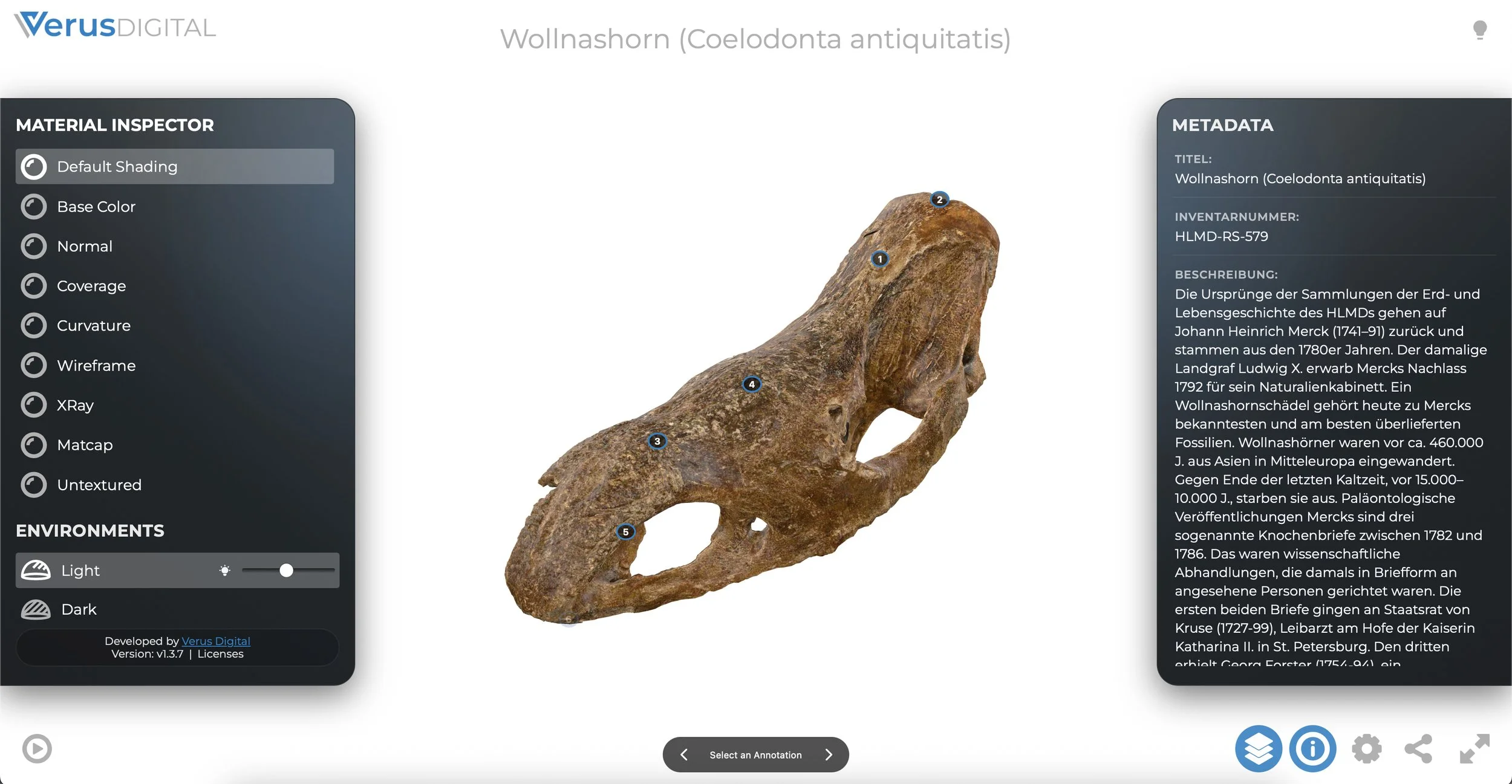
Users can now freely explore the skull in three-dimensional space on a computer, tablet, or smartphone and interact with it in a targeted way. Annotations on the model provide direct access to further information, including the fossil’s origins, distinctive anatomical features, and Johann Heinrich Merck’s other paleontological research.
This approach opens up new digital presentation possibilities for museums and scientific collections. While traditional online collections often present objects through photographs and accompanying texts, View3D combines spatial visualization and information in a single interactive experience.
Individual features, areas of damage, and research findings can thus be precisely located and explained. This functionality is particularly important for scientific documentation.
A Digital Knowledge Carrier
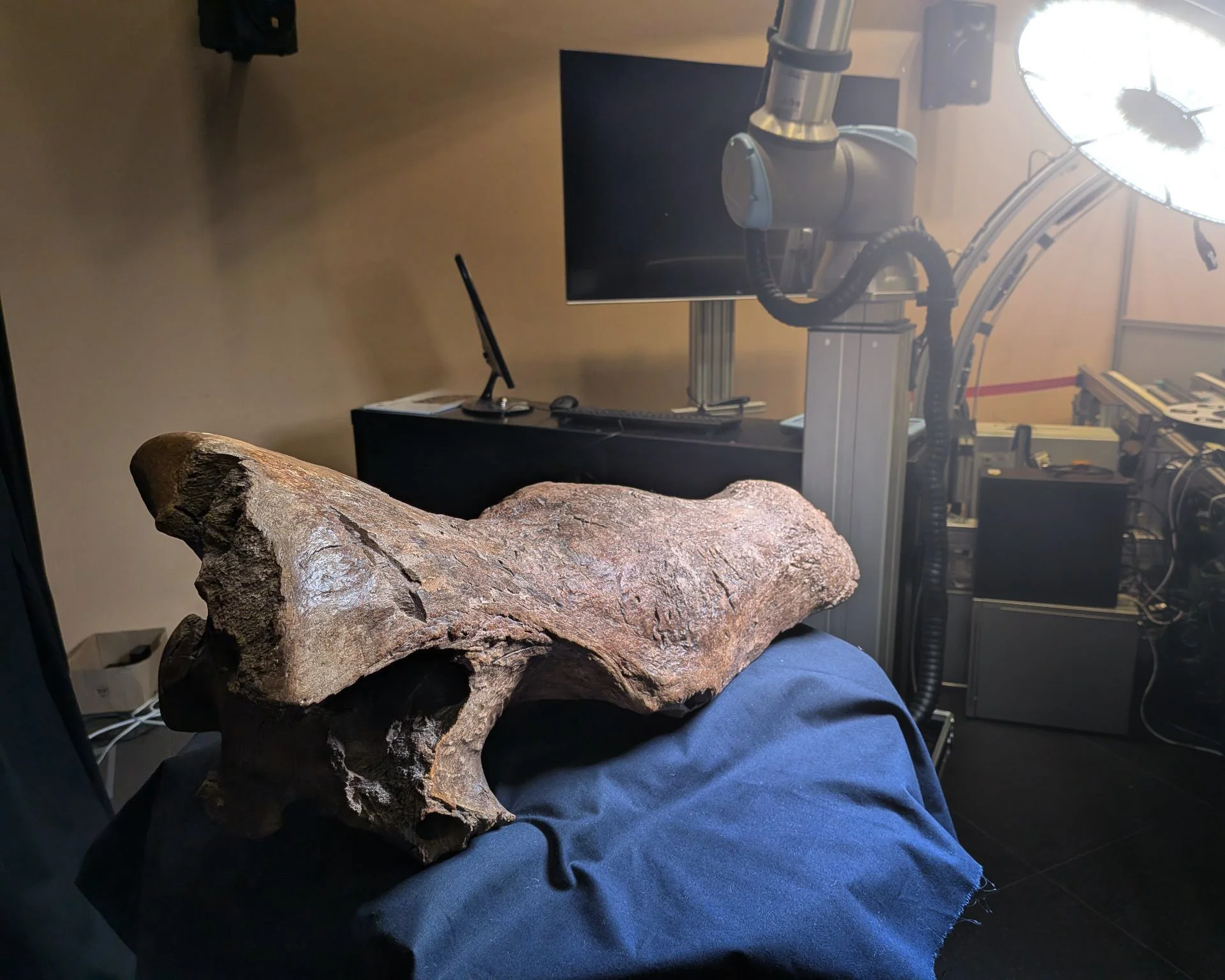
Using CultArm3D, an autonomous digitization system, the historical original was first captured with a high degree of geometric and visual precision. The resulting 3D model was then specifically optimized for web use and integrated into View3D, the web-based 3D viewer developed by the Darmstadt-based company.
A key role in the project was played by the viewer’s newly developed Annotator feature. It allows information to be linked to an object not merely in general terms, but directly to specific areas of its surface in the 3D model. Verus Digital describes this approach as a way of developing scientific 3D models into digital repositories of data and knowledge.
Matevz Domajnko, Managing Director of Verus Digital GmbH
“When it comes to digitizing cultural heritage, our goal has long since moved beyond simply creating the most accurate 3D model possible. The crucial question is what happens to that data afterward. With View3D and our Annotator, museums can link scientific information directly to the digital object. This makes scientific work and the exchange of information considerably easier.”
Dr. Oliver Sandrock, Hessisches Landesmuseum Darmstadt
“Johann Heinrich Merck’s woolly rhinoceros skull is far more than an extraordinary fossil. It marks the beginning of our collection’s history while also documenting a very early phase of scientific inquiry into evolution. Digitally capturing the object allows us to make this remarkable specimen accessible regardless of its physical location, opening up entirely new possibilities for research and presentation.”
Dr. rer. nat. Sabine Bernschneider-Reif, Head of Corporate & Family Heritage, Merck KGaA
“Johann Heinrich Merck exemplifies a spirit of curiosity that brought art, literature, and natural sciences together. The fact that a fossil he studied scientifically almost 250 years ago is now being made accessible in new ways using technology developed in Darmstadt creates a special bridge between our history and the present day.”
The project demonstrates that archiving cultural heritage today goes far beyond simply preserving and documenting historical artifacts. The collaboration between Verus Digital GmbH, the Hessisches Landesmuseum Darmstadt, and Merck KGaA provides a representative example of how historical research can be combined with modern technology to create new opportunities for education, science, and culture.